



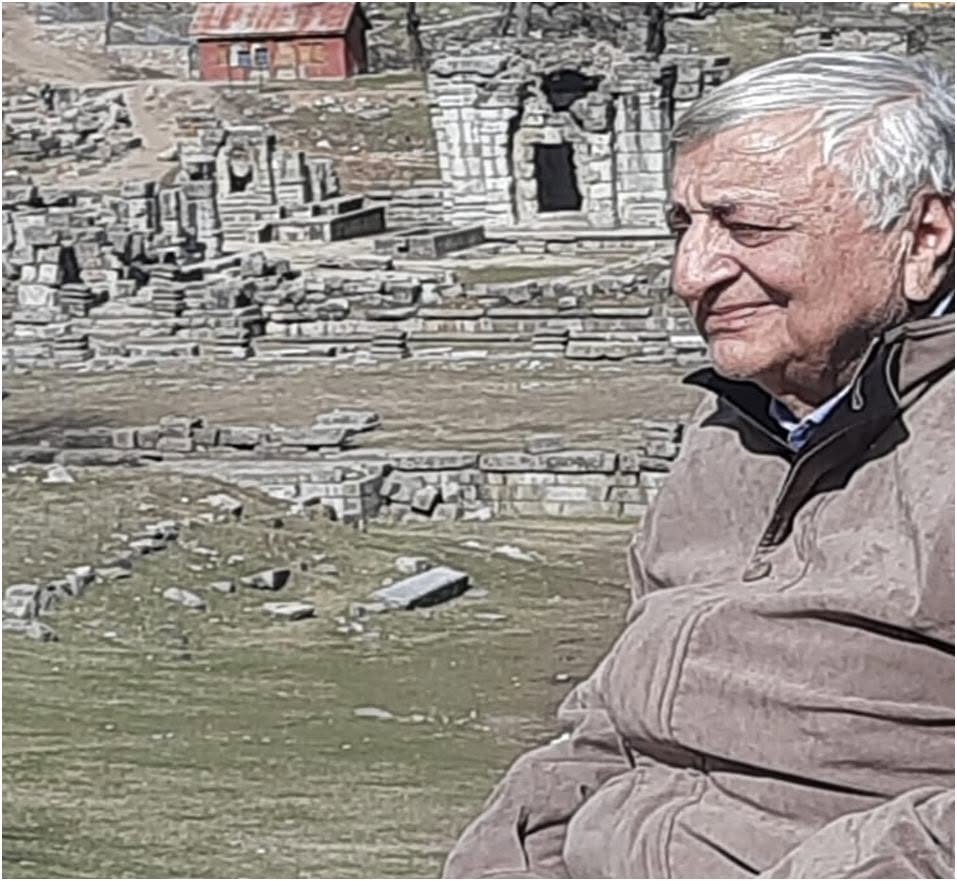
DESTRUCTION OF TEMPLES IN KASHMIR
The establishment of the supremacy of Islam in India is a part of the history of India. The commitment of the Muslims to fight idolatry found expression in the destruction of the Hindu temples, the centres of idol worship in India. “The Hindu temples are the abode of God. They are not prayer houses”. In the Hindu temples Param Parmeshwar is worshipped in the iconic forms, he assumed with the evolution of the Sanskrit civilization of India, as the manifestation of the unity of the universal existence and the embodiment of the creation. The rise of the Muslim power in India set in motion, sociological conflict. The Muslim struggle to efface the religious culture of the Hindu India formed a part of that conflict.
The Mughal conqueror Babar, who is responsible of the destruction of Ayodhya, exclaimed in ecstasy, “For Islam’s sake, I wandered in the wilds, prepared for war with Pathans and Hindus, resolved myself to meet the martyr’s death. Thanks are to God, a Ghazi I became.”
That the Muslim rulers, right from the time of the Muslim invasion of India, to the time they succeeded in establishing their way over the country, accomplished the task of destroying the Hindu temples and shrines with ferocity and zeal, is borne by the facts of history. “There is enough evidence recorded by the contemporary Muslim chronicles and British historians about the destruction of the Hindu temples and shrines by the Muslim invaders as well as emperors who established their dynasties to rule India. Muslim historians wrote of the demolition of the Hindu temples during Gaznavi’s invasion of India. “In Banaras which is the centre of the country of Hind, they destroyed the thousand temples and raised mosques on their foundations. Surat-I-Feroz recorded;”Feroz Tughlaq attacked Orissa in 1360 AD and destroyed the temple of Jaganath”.
The iconoclast zeal of the Muslim rulers did not end there. The destruction of the Hindu temples was not aimed to consolidate Muslim power in India. It was the expression of a spontaneous craving to serve the faith of Islam. “In 1731, Nasirudin Mohamad Tughlak Sultan sent Muzaffar Shah Khan to destroy the famous temple of Somnath. He demolished the temple and built a mosque over the foundations of the demolished temple. The temple had been rebuilt by the Hindus, after it was pillaged by Gaznavi’s hordes. Muzaffar Khan succeeded Nasirurdin Mohammad, after the latter’s demise in 1393. Auranzeb’s grand-daughter and the daughter of Bahadur Shah, Alamqir noted in Safiha-i-chahal Nasaih Bahadur Shahi, written and compiled in late seventeenth century and early eighteenth century. “The places of worship of Hindus situated at Mathura, Banaras and Avdh etc. in which the Hindus have great faith, the birth place of Kanahaiya, the place of Rasoi Sita, the place of Hanuman, who according to the Hindus, was seated by Ram Chandra over there, after the conquest of Lanka, were all demolished for the strength of Islam, and at these places mosques have been constructed.”
Mohamad Khilji demolished many Hindu temples and built mosques over their ruins. In 1472 AD, Mohamad Begara attacked Dwarka and destroyed the temple of Sri Krishna. During the reign of the Mughal emperor Muhammad Shah and the tenure of the governorship of Saadat Ali Khan, a serious riot took place between the Hindus and the Muslim in 1735 AD, the former claiming their right over Ram Janam Bhumi. This is the earliest judicial reference available in this regard. In Hadiqa-i-Shahada (1856) Mirza Jan wrote: “The past Sultans encouraged the propagation and glorification of Islam and crushed the forces of the unbelievers, the Hindus. Similarly, Faizabad and Avadh were also purged of the unworthy practice of Kufr. Avadh was a great worshipping centre of the capital of Kingdom of Ram’s father.” Illyas Shah demolished and destroyed Hindu temples all over South India.
There was no difference in the religious policy of the Muslim rulers in India and the religious policy of the Muslim rulers in Kashmir, who established their hold over the ancient Hindu kingdom in the early fourteenth century AD. The Muslim rulers of Kashmir disapproved of all forms of idol worship, the same way the Muslim rulers in India did. The Hindu temples and shrines, being the centres of idol worship among the Hindus, evidently attracted the wrath of the Muslim rulers, who proclaimed themselves, the defenders of their faith. In many respects the severity of persecution of the Hindus in Kashmir, was greater than in the rest of India and the temples and Hindu shrines were exposed to wider destruction, than they were in the rest of the country.
“Laltaditya, 761 A.D., founded the Karkota Empire of Kashmir. He extended his power into the upper Punjab in the south and west of India and western Tibet in the north. He built many magnificent temples in Kashmir, the most imposing of them being the temple of Martand. After him, king Avantivarman built two temples, Avanti-Swamin dedicated to Vishnu, and Avanti-Swara dedicated to Shiva. His son Sankara Varman built two elegant temples at Pattan, both dedicated to Shiva. During the reign of the Muslim Sultan Sikandar, known as the iconoclast, most of the Hindu temples were destroyed. The temple of Martand was reduced to ruins. The task of destroying the remaining temples was accomplished by Sikander’s successors. The destruction of the Hindu temples in Kashmir continued unchecked during the Chak rule, which followed the Shahmiri Sultanate, the rule of the Mughals, who wrested Kashmir from the Chaks and the Durrain Pathans, who followed the Mughals.”
Corroborating the above account, Walter R Lawrence, a British Revenue official of the Government of India, who wrote extensively on the Kashmir, writes, “After destroying most of their temples, Sikandar turned his attention to the people who worshipped there and he offered them three choices: death, conversion or exile. Tradition affirms that only eleven families of the Hindus were left alive in Kashmir.”
The demolition and destruction of the Hindu temples was a part of the Muslim policy to break the resistance of the Hindus to the consolidation of their power in India. “The demolition of the temples by the Muslims was aimed to extend the Muslim power in India and to facilitate the spread of Islam over its length and breadth. The construction of mosques over the remains of the demolished temples was aimed to prove to the Hindus that they were beyond redemption and thus pave the way for the destruction of Hinduism. A mosque was built by Sultan Qutub-din-Aibak in 1193 AD and named Quwatul-Islam Masjid. The mosque was renovated and enlarged by Shamsuddin Iltimush in 1211-36 AD and Alauddin Khilji in 1216-1316. Quwwatul-Islam Masjid symbolised the might of Islam. Pillars and the stone slabs, of as many as twenty-seven Hindu and Jain temples, demolished by the Muslim rulers, were used in the construction of the mosque. The mosque is still intact, standing in the enclosure of the Qutub Minar in Delhi….” The Muslim invaders mounted a three-pronged attack on the Hindus in Kashmir, to efface all forms of their worship, their rituals and religious practice. First, they launched a widespread campaign of forcible conversions of Hindus to Islam. Secondly, they mounted an assault to demolish the Hindu temples and places of worship. Thirdly, they destroyed the Hindu institutions of learning, burnt down their libraries and dumped piles of books and manuscripts in the Dal Lake. Among the prominent centres of learning, in the Hindu system of philosophy and Yoga, were several institutions, comparable to the modern universities. Sharda Peeth and the Sharika Peeth were the institutions, which attracted scholars from Central Asia and China were targeted. Jonaraja who left an account of the turbulent period, which followed the founding of the Shah Miri Sultanate, lamented that the Muslims fell on the Hindus as the hosts of locusts descend on cornfields.
The organized campaign of the suppression of idol worship and the destruction of temples was initiated by Sultan Sikandar, who ascended the throne in 1389 AD. Sikander, who earned the name of “But-Shiken”—-the Iconoclast, initiated a widespread drive to demolish and destroy the Hindu temples. The highly venerated shrine of Kali Shuri, in the heart of Srinagar, situated close to the Zaina Kadal Bridge, on the `eastern bank of the river Jhelum, was demolished. A Muslim shrine, the Khanquah Maula was built over the plinth of the temple. On the western bank of the river, opposite the Kali Shuri temple, were two temples, Zeshthesa Bhairov and Vishaksera Bhairov. Both the temples were demolished and turned into Muslim graveyards. Besides Martand, Sultan Sikander got the temples of Tripreshar and Surevsvati Vihara temples destroyed in South Kashmir. The ancient temple of Vijayesvara, in Bijbehara, dedicated to Shiva, and many more temples all around were demolished on the orders of Sikander. On the ruins of the temple of Tarapida was built the Jamia Masjid in 1407AD. After having demolished the temples, Sultan Sikander ordered Muslim shrines to be built over their ruins, using the stone slabs of the demolished temples, in the construction of the mosques.
As a major militant assault on the Hindus was delivered in January 1990, the Hindu temples and shrines, religious places and Hindu religious institutions, came under heavy attack of the militants. Almost all over the Kashmir province, temples were desecrated, subjected to bomb attacks and at many places, set on fire. Earlier, in the fall of 1989, the temple dedicated to Shiva, located on the northern bank of the Chunth-Kul, canal close to Barbar- Shah Bridge was burnt down.
The issue of the demolition and damage to the Hindu temples was raised in the Indian Parliament. On 12 March 1993, the Minister of State of Home in the Government of India stated in the Parliament that thirty eight Hindu temples had been demolished and damaged in Kashmir during the period from 1989 to 1991. He stated that during the year 1989, thirteen temples were demolished and damaged, during the year 1990, nine temples were demolished and damaged and during the 1991, sixteen temples were demolished and damaged.
The demolition of the Babri structure in Ayodhya on 6 December 1992, led to widespread anti-Hindu riots in Kashmir and demolition and desecration of a large number of their temples. Frenzied mobs of Muslims attacked Hindu temples, burnt them down and demolished them all over the Valley. The Hindus having already left the Valley, there was little resistance to the depredations the temples were subjected to. The White Paper on Kashmir noted; “In the aftermath of the demolition of the Babri Masjid, traditional Muslim intolerance towards the Hindus, erupted into widespread attack on the Hindu temples and places of worship. Thirty nine temples were demolished, burnt, damaged and desecrated by frenzied mobs, who cried death to India and death to the Hindus.”
(Excerpts from Kashmir—Hindu Shrines by Chaman Lal Gadoo)