


On Ashad Shukla Chaturdashi, fourteenth bright fortnight of June-July every year, a great festival is held at Krew town of Pulmawa district, Kashmir, to celebrate Jawala Jayanti, the birthday of the Goddess Jawala locally known as Zala Bhagwati. During Jwalamukhi Mela devotees participate in day long Bhajn /Kirtan and perform Puja Archana of Goddess in a traditional way.
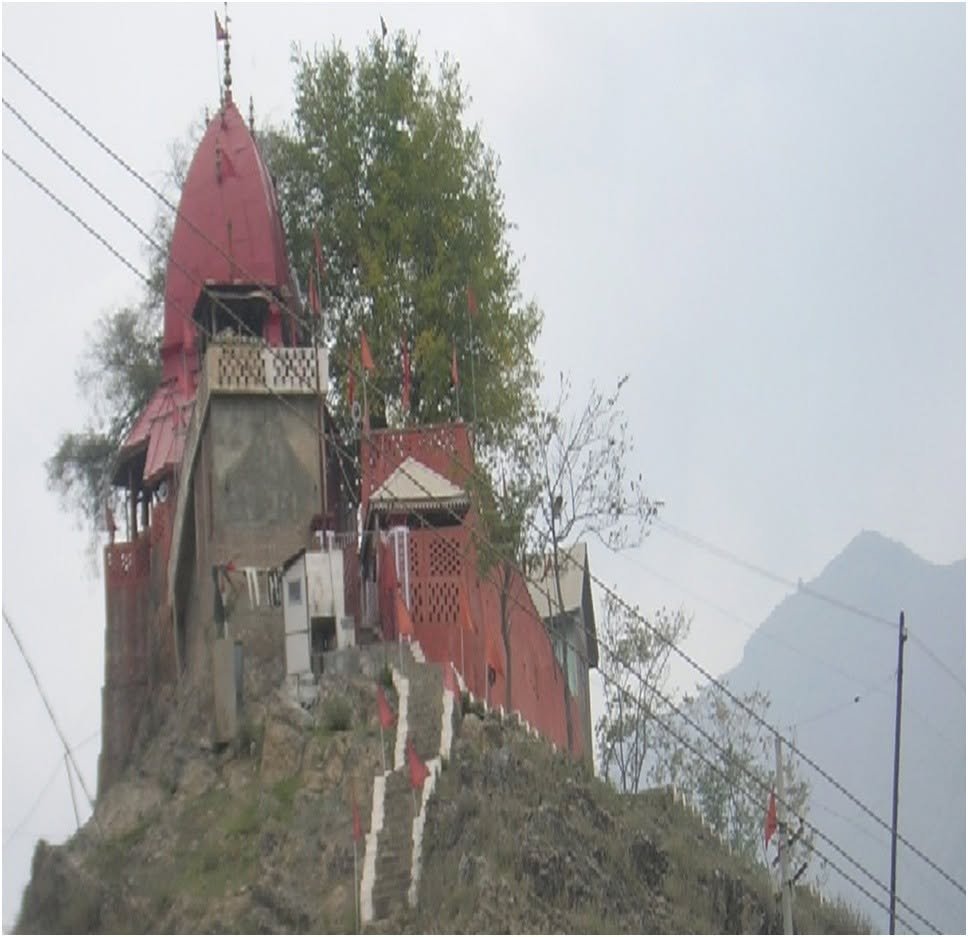
Khrew is derived from Sanskrit word Kharwata, meaning ‘mountain village’. Jawala, the Goddess of Fire, is another Isht Devi of Kashmiri Hindus. The temple of Jawala is situated on a hillock in the village of Khrew about twenty- three kilometers away to the south-east of Srinagar. The shrine of Jawala was constructed by Raja Daya Krishan Koul during the twentieth century.
It is believed that Jwalaji appeared here in the form of Jyoti before the construction of the temple. It was approachable originally by a flight of 365 steps but now by 320 steps only made of dressed stone. With this shrine, there also is a temple dedicated to Bhairava. Bhairava being the protector, is also offered prayers by the devotees who visit the shrine.
The octagonal shaped temple rests on an eighteen feet high base. The Sanctum Sanctorum is an eight by eight feet square shaped structure. The ceiling of wide dome is decorated with Khatamband design, which has now started decaying and crumbling at several places. Jawala remains physically manifest in the form of a ‘Jyoti’ at the hill top. Inside the sanctum sanctorum of the temple there is a Shila in the form of natural stone of 4 feet height, 4 feet length and 3 feet width, which is smeared with sindoor. This sacred Shila has naturally carved mystical lines forming triangles and hexagons in the shape of Sri Chakram. It is belived that the Shila turned black due to the occasional flames which sparked here from time to time. The worship of Svayambhu Shila and Cosmic Yantra is regarded as the highest form of worship in the Devi Puja tradition.
Kalhana refers to the village Khrew in ‘Rajtarangini’ as ‘Khaduvi’, where according to him, there were three hundred and sixty springs of fresh water in ancient times. He mentions that on the hill-side to the east of the village, there was a standing rock on which a Svayambhu-Chakra or ‘mystical diagram’ was drawn. At present, three prominent springs still exist, the most important is ‘Bod Nag’ which is located close to the temple. This spring is 40 feet wide and 60 feet in length and 3 feet deep and is under the shade of three Chinar trees. It is also known as Nagbal. There is no ‘Linga’ inside the temple but a number of ‘Shivaligas’ are around all the springs. A six hundred years old idol of Laxmi Narayan is also standing near the Bod Nag. Another idol, believed to be nine hundred year old stands to the west of the Bod Nag. The idol is of the Goddess Maharajini.
The springs of Khrew have perennial source of fresh water which come straight from the mountain glaciers. The water of the springs of the shrine, also known as Nagbal, flows out into a wide stream, which is known as Kol. The water is crystal clear, about two feet deep. Its width varies from five to ten meters. After traversing a distance of about five miles, this Kol joins Vitasta at Pampore.
On the left side of the ‘Jawala Parbat’ is the revered hill of ‘Vishnu Pad’. It is considered to be a sacred hill venerated by Hindus. At the top of the Vishnu Pad hill is a stone rock with a foot mark on it. According to tradition, the foot mark is that of Lord Vishnu. In ancient times, pilgrims used to climb the hill and worship Lord Vishnu, but such pilgrimage is no longer in practise now.
(Excerpts from the book, Kashmir— Hindu Shrines by Chaman Lal Gadoo)